Tuesday, March 17, 2020

Saturday, January 11, 2020
Myanmar observations
In the beginning of 2019, a letter came to our mailbox in Copenhagen, containing an invitation to Ragni and Kaung Htet Aung’s wedding in Myanmar. We were so excited, and immediately knew that we would make the trip to experience this. Knowing little about Myanmar beforehand, we started doing some brief research. During CPH DOX in March (the documentary festival of Copenhagen) we saw the movie “Scener fra et militærdiktatur” (On the inside of a military dictatorship), which gave us a good introduction to the history of Myanmar and its current political situation.
As the trip came closer, we also started reading travel blogs with tips and info about south east Asia, but even though preparations are king, we still had no idea what was expecting us in this newly opened country. On the plane from Oslo to Bangkok, I was thinking about all the things I still had to learn about Myanmar, the things that can only be learned by traveling there, and by being in contact with the locals. The sounds, the smells, and the little details within the culture, that you pick up along the way. I would like to sum up some of those little details that I explored on our 10 day trip to Myanmar.


As the trip came closer, we also started reading travel blogs with tips and info about south east Asia, but even though preparations are king, we still had no idea what was expecting us in this newly opened country. On the plane from Oslo to Bangkok, I was thinking about all the things I still had to learn about Myanmar, the things that can only be learned by traveling there, and by being in contact with the locals. The sounds, the smells, and the little details within the culture, that you pick up along the way. I would like to sum up some of those little details that I explored on our 10 day trip to Myanmar.
- "Everyone" chews on a little red nut called Betel, which makes their teeth and spit red, and they spit it on the ground so that there are little red spots everywhere on the pavements.
- The traditional "Longyi" is both for men and women. But we soon found out that the way of wearing it is quite different, as the men's Longyi is tied in a front knot and is called paso, and the women fold it on the side and call it tamein. Our boys found out the hard way on the day of Ragni and Kaung Htet's wedding, as they had folded the Longyi the female way, and the locals kept pointing and laughing at them. Luckily, Kaung Htet was there to help, and carefully made sure the boys were dressed appropriately.


- Everyone has an iphone or smartphone. We were quite fascinated with how they could walk around with their phone in the sides of the longyi without them falling down and breaking.
- The locals wear a kind of make-up, thanakha, which is used for both sunblock and aesthetic reasons. The yellow-gold paste is used differently, but I noticed that both men and women use it. Therefore I have a theory that the beauty ideals of men and women are quite similar in Myanmar; men and women both wear the Longyi, and both genders wear the thanakha.
- If they ask of you want your food "spicy", you are already in trouble. Each time I got asked if I wanted the dish "spicy", and made it very clear that I am not good at eating spicy food, I got a dish so hot I could barely handle the spices. The times I did not get this question, there was no problem. So when they ask "spicy?", the dish is already quite spicy and they just want to know on what level to finish the dish.

- Sunbathing in Myanmar was quite chill, as we had the pool and the beach to ourselves most of the time. Different parts of the world have different beauty ideals, and one quite distinct one is tan. As we Scandis wanted to take advantage of the sun and get a little color, the Asian hotel guests were not as enthusiastic. Our hotel in Ngwe Saung also hosted guests from China and Myanmar, but none of those guests joined us by the pool before late afternoon, when the sun was about to set. White skin as a beauty ideal was also made clear when I saw this beauty product in a store:

- Even though the Burmese people don’t speak a lot of English, we managed to communicate, thanks to their warm hearts and welcoming spirits. The burmese also had such beautiful smiles, and lovely laughs, which quickly turned a stranger into a friend. Being a blonde Scandi girl raging 187cm above the ground, I also made it as a popular photo object with many locals.

I would like to thank Ragni and Kaung Htet for letting us participate on their big day. We had such a great trip to Myanmar, and are so happy to have learned more about Kaung Htet's home country and culture. We will always remember your special day, and always have Myanmar in our hearts!
At last a little recap of the journey with some of Knut's best shots:
 |
| A woman selling vegetables on the street in Yangon. |
 |
| A visit to Myanmar's biggest pagoda. |
 |
| Shwedagon Pagoda in the sunset. |


 |
| Driving a tuk-tuk in Ngwe Saung. |
 |
| The sunsets in Ngwe Saung were so beautiful |
 |
| A very happy couple visiting Shwedagon Pagoda on Christmas eve. |
- A <3 K
Thursday, October 31, 2019
Looking back at the summer of 2019 - Paros - Greece
In the last week of July, we went to Greece for a little beach vacation together with Makayla. Knut had not been to Greece before, and I had only visited Athens (during winter), and not the islands, so we were both very excited to see the beaches and eat the delicious Greek food.
On Paros we rented an Airbnb-apartment in the village of Dryos. The apartment was typically Greek; white and blue, and with a beautiful view over the beach and ocean. The days were mainly spent on the beach, with a coffee freddo (sweet Greek iced coffee, perfect for a sweet tooth like me), and a dip in the water once in a while.
In the evenings we tried different restaurants in the area, and tasted some really great local food. The northernmost village Naousa was definitely my favorite on Paros. Such a charming town, with white houses, narrow streets, and small design shops. Even though there were a lot of tourists, I didn't think that stood in the way of getting a good experience in the town. They were obviously used to having a lot of people visiting in July, and made the best out of it.

It was a great adventure together with our favorite Texan, and we can't wait to see you again and explore more random places in the world with you! ♥
On Paros we rented an Airbnb-apartment in the village of Dryos. The apartment was typically Greek; white and blue, and with a beautiful view over the beach and ocean. The days were mainly spent on the beach, with a coffee freddo (sweet Greek iced coffee, perfect for a sweet tooth like me), and a dip in the water once in a while.
In the evenings we tried different restaurants in the area, and tasted some really great local food. The northernmost village Naousa was definitely my favorite on Paros. Such a charming town, with white houses, narrow streets, and small design shops. Even though there were a lot of tourists, I didn't think that stood in the way of getting a good experience in the town. They were obviously used to having a lot of people visiting in July, and made the best out of it.
 |
| Enjoying our first evening in Naousa. |
 |
| Posing in front of one of many beautiful window frames. |
 |
| A local sight of squids drying outside of restaurants. |
 |
| Hand in hand on Antiparos ♥ |
 |
| The sunset seen from the village Parikia. |

 |
| Enjoying the beach and the warm weather. |
 |
| Enjoying a sweet coffee freddo ♥ |
 |
| One of the many churches on Paros. I love the white and blue colors together with the pink flowers. |
 |
| Knut made a new friend. |
 |
| Makayla picked fruits from a random garden on Antiparos. |
 |
| Enjoying some local wine in Naousa on our last evening. |
It was a great adventure together with our favorite Texan, and we can't wait to see you again and explore more random places in the world with you! ♥
Looking back at the summer of 2019 - Norway
The summer of 2019 was the first summer we both did not work and got to spend a lot of quality time together. Not only as boyfriend and girlfriend, but one of the first days of vacation, we also got engaged! So we got to spend our summer as newly engaged together in a lot of lovely places and with so many of our family and friends.
Our summer started on the 1st of July, when we moved to Norway from Copenhagen. It was a stressful day, starting with a flight from Copenhagen to Oslo with no less than 10 pieces of luggage. We went to IKEA, and I was not expecting anything, until the evening, Knut asked me to marry him and it was such a pleasant surprise. Our new home was loaded with IKEA-boxes and we had only just starting to put up the furniture, but during the next couple of days, the apartment started to look pretty good.
After a couple of days of furnishing and stressing over IKEA-furniture (it's safe to say I am not a fan of IKEA), we went to an island in the south of Norway, Lyngør, to visit our friends who have a cabin/ summer house there. It was such a lovely trip, and such an idyllic location. The old, white tree houses, the sailboats, the fishing (and also catching) and just the thought of not having to do anything was amazing. The mackerel tasted even better than usual when we caught it ourselves, and the sunny weather did us good.


Our summer started on the 1st of July, when we moved to Norway from Copenhagen. It was a stressful day, starting with a flight from Copenhagen to Oslo with no less than 10 pieces of luggage. We went to IKEA, and I was not expecting anything, until the evening, Knut asked me to marry him and it was such a pleasant surprise. Our new home was loaded with IKEA-boxes and we had only just starting to put up the furniture, but during the next couple of days, the apartment started to look pretty good.
After a couple of days of furnishing and stressing over IKEA-furniture (it's safe to say I am not a fan of IKEA), we went to an island in the south of Norway, Lyngør, to visit our friends who have a cabin/ summer house there. It was such a lovely trip, and such an idyllic location. The old, white tree houses, the sailboats, the fishing (and also catching) and just the thought of not having to do anything was amazing. The mackerel tasted even better than usual when we caught it ourselves, and the sunny weather did us good.
 |
| Knut took some beautiful pictures of Lyngør! |
 |
| Always happiest at sea. |

 |
| Fishing at the pier. |
 |
| And caught one mackerel! |
Next in line was the Molde International Jazz Festival, that we go to every year. This year's headlines were amongst others some of my all time favorites; Melody Gardot, Marcus Miller and Gregory Porter. We had a lovely festival experience (as always) with friends and family, and ended the week by celebrating the 50 year anniversary of the Moon landing (on July 20th 1969) with a Moon Party with our friends. The perfect end of a pretty awesome week!
 |
| Always a good mood during the jazz festival! |
 |
| The guys getting a beer on the roof top Hawaii party. |
 |
| Louis Cole and his band were very entertaining and funky, and gave us a catchy, upbeat show. |
 |
| The weather was also nice, and we took a swim at Hjertøya. |
 |
| Fimke and me at the Moon Party celebrating the 50th anniversary of the Moon landing. |
 |
| The Moon Party. <3 |
(Right after the festival, we flew to Athens, for a little vacation on the island Paros, which I will write a separate blog post on.)
As a last little trip before the semester started at the university, we went to our friends' cabin out by the coast of Telemark. Again, we were welcomed with such sweet hospitality in company of good friends, and enjoyed ourselves to the fullest. The days were enjoyed eating good food, playing games, and fishing (but not with the same luck as last time).
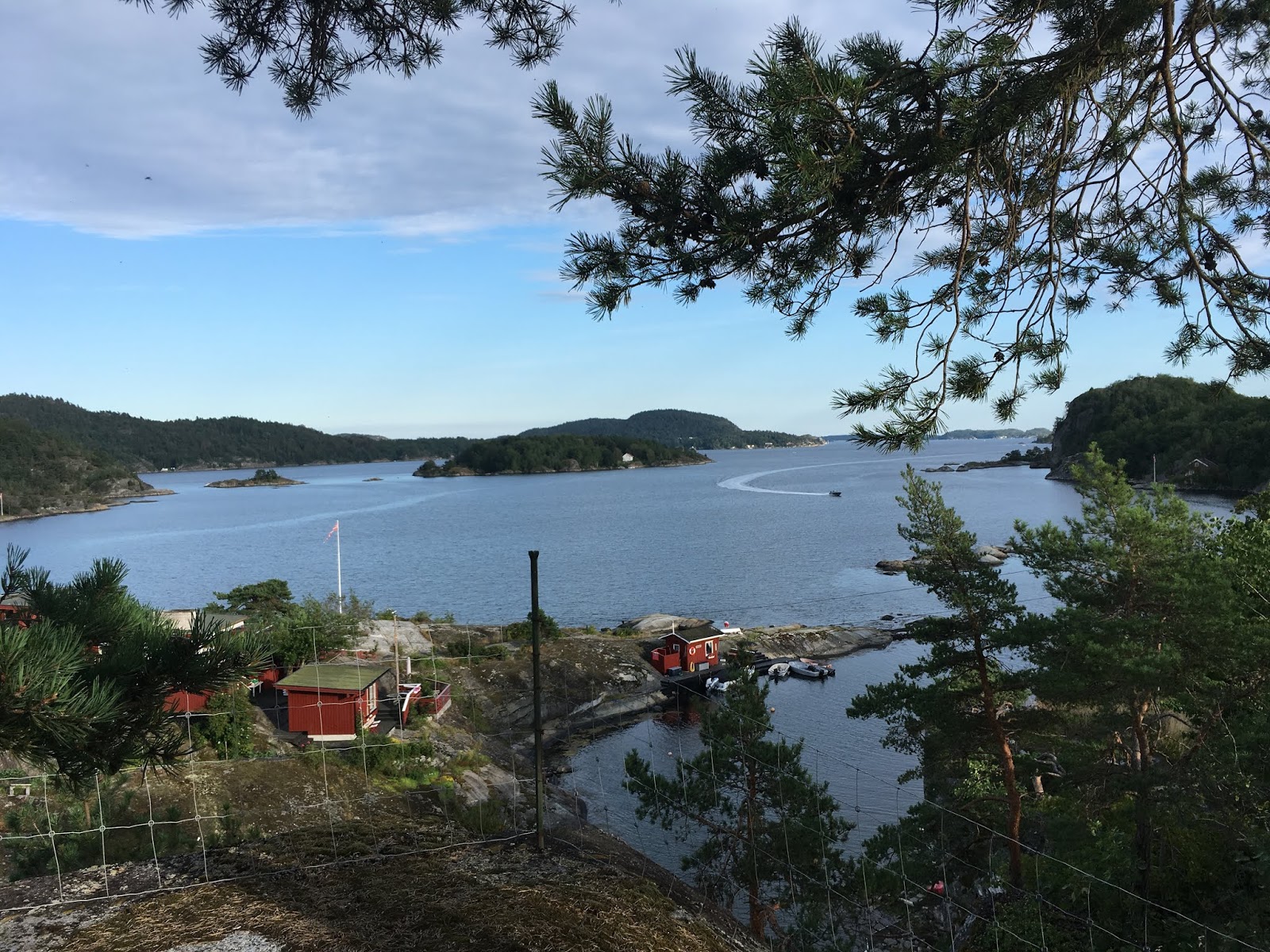 |
| The view from the cabin. So cute and peaceful. |

 |
| Dinner in good company <3 |
All in all a very busy summer even though we did not work. Traveling to the west and east of Norway, to Greece and of course moving our lives from Copenhagen to Ås. We have a lot of good memories to look back at from the summer of 2019, and now that we are almost in November, it is nice to look back at the good, sunny days.
-A ♥
Thursday, May 2, 2019
Nordjylland
A couple of weeks before easter, Knut randomly said to me "I really want to go to the north of the country!", and we immediately started planning a trip up north, to beautiful Jylland. We got a lot of good recommendations from our Danish friends, and the sweetest couple in the world, Olivia and Vincent, borrowed us their car, and we were good to go.
Our trip was 4 days long, which is really short for driving back and forth from Copenhagen to Nordjylland, but we had a great trip, and just narrowed down every bit of what we wanted to see and do.
Day one, roadtrip + Skagen:
The first day was just a long roadtrip from Copenhagen to the northernmost city in Denmark, Skagen. The drive was about 6 hours long, including stops, but it was really nice weather along the way, and the music on the radio kept us in good company.
Right before we arrived in Skagen, and right before the sun was about to set, we stopped at Den Tilsandede Kirke, and Knut shot some beautiful photos of the church in the sunset!
In Skagen, we got dinner at Bodilles Kro, where we got a delicious fish soup and fresh fish from Hirtshals. We stayed at Hotel Petit, a really cute hotel with a sweet and welcoming staff.
Day 2 and 3, roadtripping down to Aalborg, + Aalborg:
The next day was a monday, and we got up, ate breakfast and went for a walk in the city centre. It was as dead and abandoned as a small town can be on a morning before 10 am, but fortunately, the sun was shining, and the buildings and the harbor area were charming and lovely to look at. After our little walk, we drove to the northernmost point of the Danish mainland, Grenen.
The beach and area Grenen was so beautiful on this sunny day, and the big, white sanded beach gave me associations to the white beach scene in Pirates of the Caribbean.
Next, we drove west on the Marguerite Route, and stopped in Rubjerg Knude Fyr. Knut had only seen pictures of the lighthouse on Instagram, but really wanted to stop there, and it turned out to be the highlight of the trip. The lighthouse is located down by the ocean, but is no longer active, because it was damaged by all the sand that covered it, and because it is located on moraine, it will most likely sink into the water within the next 3-5 years. The walk from the parking and up to the lighthouse was like walking through a desert, and was something I never thought I would experience in Denmark. A trip to Rubjerg Knude Fyr is absolute worth a visit.
Next stop was just a 15 min drive away, the little town Løkken. There we ate a big ice cream, and took a walk on the beach (where surfing was possible, but too cold that day!), and enjoyed the charming city.
Last stop that day was Aalborg, where we were staying for two nights. Thanks to my good friend Nanna, we hade more than enough to do in Aalborg, since she had sent me a looong list of a local's recommendations on what to do.
Aalborg was beautiful. In short, it is my new favorite city of Denmark! Copenhagen has (almost) nothing on Aalborg. ;) So charming, and so beautiful. The city centre is really old, but the buildings are well preserved, and makes the city really special. The city has a long history, and the fact that this was for long the second biggest city in Denmark, and an important city to the King, is quite fascinating.
My favorite part was walking along the "fjord" on the first evening (I have to put "" around fjord here because the Norwegian perception of the word fjord is not what I saw in Limfjorden in Aalborg. Sorry, Denmark.) The sun had just set, and the pink and purple sky over the quiet city was just amazing to look at. The harbor has a lot of new and modern buildings, like the Utzon center and Musikkens Hus, which both bring some modern feeling in to the old city. Just lovely!
The next day, we spent walking through the city, doing some shopping, enjoying the sun, eating and drinking in all the right cafés and restaurants, thanks to Nanna, and at last, seing Captain Marvel in the cinema.
Day 4, Århus:
Our last day, we drove early from Aalborg, so we arrived in Århus right on time for AROS to open. AROS is a museum of modern art, that I really only wanted to visit because of its famous rainbow on top. The museum itself is not very pretty from the outside, but the rainbow on the roof does all the work to make the building interesting and worth a look.
After walking around in AROS for a while, and among others seing an installation by the Japanese LABPlanets (which we also saw in Tokyo), we went to the next museum, and highlight of the day: Den Gamle By (The Old Town). Den Gamle By is absolutely worth a visit, and we learned so much about Danish history (which is in many ways also Norwegian history). The houses and the clothes and the atmosphere were all so authentic, and really gave us a great experience the whole day through.
Thank you so much to everyone who sent us recommendations to this trip, and thank you Denmark, for being so damn likable!!
All pictures are of course taken by the world's best Knut!
Our trip was 4 days long, which is really short for driving back and forth from Copenhagen to Nordjylland, but we had a great trip, and just narrowed down every bit of what we wanted to see and do.
Day one, roadtrip + Skagen:
The first day was just a long roadtrip from Copenhagen to the northernmost city in Denmark, Skagen. The drive was about 6 hours long, including stops, but it was really nice weather along the way, and the music on the radio kept us in good company.
Right before we arrived in Skagen, and right before the sun was about to set, we stopped at Den Tilsandede Kirke, and Knut shot some beautiful photos of the church in the sunset!
In Skagen, we got dinner at Bodilles Kro, where we got a delicious fish soup and fresh fish from Hirtshals. We stayed at Hotel Petit, a really cute hotel with a sweet and welcoming staff.
 |
| Den tilsandede kirke in sunset |
The next day was a monday, and we got up, ate breakfast and went for a walk in the city centre. It was as dead and abandoned as a small town can be on a morning before 10 am, but fortunately, the sun was shining, and the buildings and the harbor area were charming and lovely to look at. After our little walk, we drove to the northernmost point of the Danish mainland, Grenen.
The beach and area Grenen was so beautiful on this sunny day, and the big, white sanded beach gave me associations to the white beach scene in Pirates of the Caribbean.
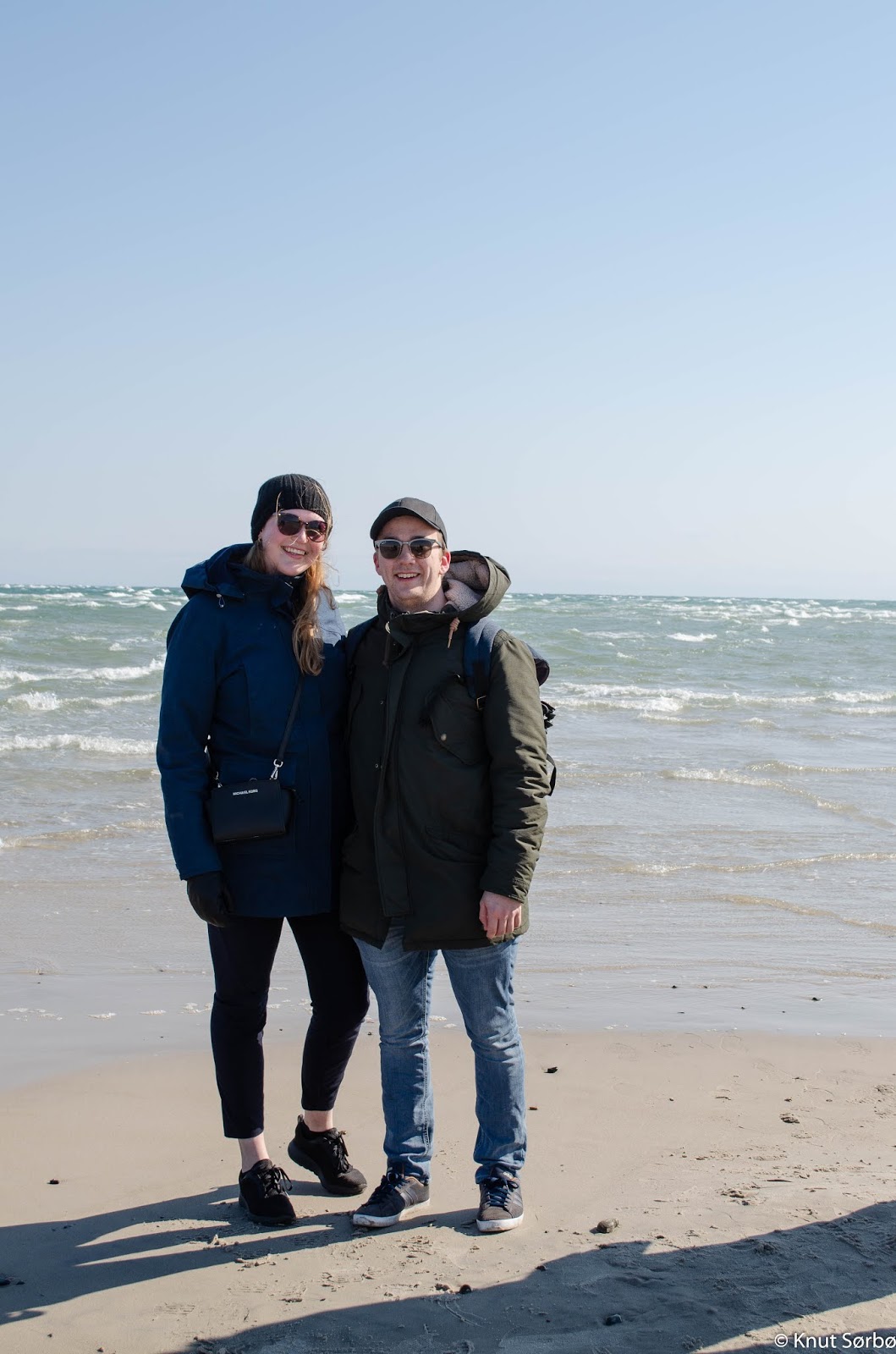 |
| My favorite travel buddy! Great shot by a German tourist at Grenen, the tip of Denmark. |
Next, we drove west on the Marguerite Route, and stopped in Rubjerg Knude Fyr. Knut had only seen pictures of the lighthouse on Instagram, but really wanted to stop there, and it turned out to be the highlight of the trip. The lighthouse is located down by the ocean, but is no longer active, because it was damaged by all the sand that covered it, and because it is located on moraine, it will most likely sink into the water within the next 3-5 years. The walk from the parking and up to the lighthouse was like walking through a desert, and was something I never thought I would experience in Denmark. A trip to Rubjerg Knude Fyr is absolute worth a visit.
 |
| Me trying to lay on the wind at Rubjerg Knude Fyr |
Next stop was just a 15 min drive away, the little town Løkken. There we ate a big ice cream, and took a walk on the beach (where surfing was possible, but too cold that day!), and enjoyed the charming city.
Last stop that day was Aalborg, where we were staying for two nights. Thanks to my good friend Nanna, we hade more than enough to do in Aalborg, since she had sent me a looong list of a local's recommendations on what to do.
Aalborg was beautiful. In short, it is my new favorite city of Denmark! Copenhagen has (almost) nothing on Aalborg. ;) So charming, and so beautiful. The city centre is really old, but the buildings are well preserved, and makes the city really special. The city has a long history, and the fact that this was for long the second biggest city in Denmark, and an important city to the King, is quite fascinating.
My favorite part was walking along the "fjord" on the first evening (I have to put "" around fjord here because the Norwegian perception of the word fjord is not what I saw in Limfjorden in Aalborg. Sorry, Denmark.) The sun had just set, and the pink and purple sky over the quiet city was just amazing to look at. The harbor has a lot of new and modern buildings, like the Utzon center and Musikkens Hus, which both bring some modern feeling in to the old city. Just lovely!
The next day, we spent walking through the city, doing some shopping, enjoying the sun, eating and drinking in all the right cafés and restaurants, thanks to Nanna, and at last, seing Captain Marvel in the cinema.
Day 4, Århus:
Our last day, we drove early from Aalborg, so we arrived in Århus right on time for AROS to open. AROS is a museum of modern art, that I really only wanted to visit because of its famous rainbow on top. The museum itself is not very pretty from the outside, but the rainbow on the roof does all the work to make the building interesting and worth a look.
After walking around in AROS for a while, and among others seing an installation by the Japanese LABPlanets (which we also saw in Tokyo), we went to the next museum, and highlight of the day: Den Gamle By (The Old Town). Den Gamle By is absolutely worth a visit, and we learned so much about Danish history (which is in many ways also Norwegian history). The houses and the clothes and the atmosphere were all so authentic, and really gave us a great experience the whole day through.
 |
| The installation "Tomorrow is the question" by LABPlanets |
 |
| Beautiful installation in AROS. |
 |
| Great shot of the 18th century houses in Den Gamle By. |
Thank you so much to everyone who sent us recommendations to this trip, and thank you Denmark, for being so damn likable!!
All pictures are of course taken by the world's best Knut!
Friday, February 15, 2019
Tokyo Part 1. What I found most fascinating about the Japanese culture.
Ever since I was little, the far east has been a big mystery to me. I have not really been interested in it, and it has just been something far away, that I never thought I would really discover. Japan was just one of those countries, that from the outside looks like a big industry country, which is super technological, and has very delicious food. At least, those were my super ignorant thoughts.
Until the autumn of 2017, when Knut started working in Sticks'n'sushi, the leading Sushi restaurant in Copenhagen, I had no idea about how rich the Japanese culture is. Sticks'n'sushi blends the Danish and Japanese culture very elegantly, and serves the best sushi that I know of (in the west, of course), but it also teaches you a lot about the Japanese culture. When you enter, they all scream "Irasshaimase!", meaning "Welcome", and you get a "Oshibori" (hot towel to clean your hands) once you get seated. They have a great selection of sushi and other Japanese foods, for example miso soup, and of course a lot of Sake. Therefore, after Knut started working there, I have gotten more and more interested in the Japanese culture.
Judging by my travel journal, that I wrote during the flight to Tokyo, about my expectations for this trip, I had absolutely no idea what I was about to see. And of course a week in a whole new country and culture is not nearly enough to learn it all (can an "outsider" even learn everything about a culture that is not one's own?), but I am back in Copenhagen with a lot of impressions, and inspiration. The Japanese culture really inspired me, and here are some of the observations from the Japanese culture that fascinates me the most:
- The Japanese are always well dressed. On our last evening, Knut and I discussed what was our favourite part about our journey. He of course answered the food, but I actually had to think about it for a while. And my final conclusion was actually that my favourite part was the people-watching, and how incredibly inspiring it was for me to see how well-dressed the Japanese were. People had very nice clothes, made from quality fabrics, hardly anyone wore sneakers, and everyone had their hair and makeup very neatly.
- The Japanese never talk loudly in public. As a pretty loud speaking woman, I really had to adjust to this one. Everywhere we went; restaurants, cafés, stores, the metro, even walking in the streets, it was always really quiet, and after a day or two, we discovered why: the people don't talk to each other in public! And for a very technical reason, that more and more cars are hybrids or electric, the traffic is also very quiet, so at one point when we were out walking the only sound we could actually hear (this was in a very crowded street), were the heels clicking on the pavement.
- All the menus in restaurants have pictures on them. This one was pretty much a life-saver for us. We had expected people to be speaking English, but actually, very few people could communicate in a reasonable level of English. So when ordering food, we ended up just pointing at whatever looked good on the menu, and hoping that it tasted as good as it looked. But actually, we had nothing to worry about, because everything tasted delicious.
- The food. Oh, the food.
- Arigato Gozaimasu! (Meaning thank you very much) The Japanese were incredibly polite and helpful to us, and wherever we went, people were always there to help, even though we could not understand each other (google translate is your friend). Even though they had helped us, they always ended up saying Arigato Gozaimasu while bowing, and after just a couple of days, we did the same.
- People at work, everywhere. During our week in Tokyo, we had to google the unemployment rate of Japan, because people were at work everywhere. Along the streets, people in uniforms were showing the way, as construction workers were fixing the roads. In the museums, there were (at least) twice as many museum guides as museum guests, and in the train stations, a lot of people were at work, even though we were not really sure what their job was. And our assumption was right. The unemployment rate of Japan is 2,4%, amongst the lowest in the world! And it really impressed me, how well-organized the society is when everyone is at work, and keeping the streets clean and the trains running.
- Respectful to their cultural heritage, while also leading within technology. How do I even explain this one... Tokyo had a lot of parks, and in a lot of these parks, there were old temples, and a lot of old history to be reminded of. Outside of these parks, the Japanese busy society was living its busy, technological life, but inside the park, there was enough space for nature and old history to keep on living their lives. This beautiful contrast inspired me so much. On our second day in Tokyo, we went to one of the many parks, and visited a little tea house. Before we went in, we had to take off our shoes, and we were seated on mats on the floor. Even though we could hear some of the traffic of the roads outside of the park, the atmosphere and the quietness inside the teahouse was an amazing experience. And I have to admit, after finishing my 7th year at school, I have not really been sitting on the floor that much, and my body kind of hurt after just a short time. But it was also very nice to experience how much you are in contact with your body while sitting on the floor, compared to sitting on a chair.

- Kids are incredibly quiet and polite. As I mentioned, the metro, the streets, and also the restaurants of Tokyo were very quiet, since the people did not talk, or talked very softly, to each other. This also counts for the children. In the weekdays, we saw Japanese kids in the cutest little school uniforms everywhere, sometimes in groups, especially during lunch-time and after school-time, and they never made any noise! Just politely lined up, talking quietly to each other, or of course, looking at their phones.
- "Where is the chocolate?!" Everyone who knows me, knows how much I love candy, and especially chocolate. Therefore, it was actually a huge disappointment to go to the candy shops in Japan, which had a very narrow selection of chocolate. And the weirdest thing, was that almost all Japanese candy contained red beans! I would have never thought that anyone would make candy of red beans, but they do, and they enjoy it. I was sceptic, and tasted a few different candies, but I have to say I really missed chocolate over there. But my absolute favorite candy was Mochi! Colorful, sweet, and very "kawaii" (meaning "cute"). I have not seen Mochi anywhere in Scandinavia yet, but hope it will make its way here some time.
These are some of my observations on Japanese culture. I am amazed by their culture, and how neat everything is, and ever since arriving home, I have considered changing my whole wardrobe to only Uniqlo-clothes. One day...♥
Until the autumn of 2017, when Knut started working in Sticks'n'sushi, the leading Sushi restaurant in Copenhagen, I had no idea about how rich the Japanese culture is. Sticks'n'sushi blends the Danish and Japanese culture very elegantly, and serves the best sushi that I know of (in the west, of course), but it also teaches you a lot about the Japanese culture. When you enter, they all scream "Irasshaimase!", meaning "Welcome", and you get a "Oshibori" (hot towel to clean your hands) once you get seated. They have a great selection of sushi and other Japanese foods, for example miso soup, and of course a lot of Sake. Therefore, after Knut started working there, I have gotten more and more interested in the Japanese culture.
Judging by my travel journal, that I wrote during the flight to Tokyo, about my expectations for this trip, I had absolutely no idea what I was about to see. And of course a week in a whole new country and culture is not nearly enough to learn it all (can an "outsider" even learn everything about a culture that is not one's own?), but I am back in Copenhagen with a lot of impressions, and inspiration. The Japanese culture really inspired me, and here are some of the observations from the Japanese culture that fascinates me the most:
- The Japanese are always well dressed. On our last evening, Knut and I discussed what was our favourite part about our journey. He of course answered the food, but I actually had to think about it for a while. And my final conclusion was actually that my favourite part was the people-watching, and how incredibly inspiring it was for me to see how well-dressed the Japanese were. People had very nice clothes, made from quality fabrics, hardly anyone wore sneakers, and everyone had their hair and makeup very neatly.
 |
| Somewhere near Shibuya station. But look at the women in the background, with their beautiful coats! I look so touristy and dumb with my winter jacket and beanie. |
 |
| Women wearing the traditional Kimono. In the Asakusa area, a lot of people were wearing traditional costumes, and it was so beautiful to look at. |
- The Japanese never talk loudly in public. As a pretty loud speaking woman, I really had to adjust to this one. Everywhere we went; restaurants, cafés, stores, the metro, even walking in the streets, it was always really quiet, and after a day or two, we discovered why: the people don't talk to each other in public! And for a very technical reason, that more and more cars are hybrids or electric, the traffic is also very quiet, so at one point when we were out walking the only sound we could actually hear (this was in a very crowded street), were the heels clicking on the pavement.
- All the menus in restaurants have pictures on them. This one was pretty much a life-saver for us. We had expected people to be speaking English, but actually, very few people could communicate in a reasonable level of English. So when ordering food, we ended up just pointing at whatever looked good on the menu, and hoping that it tasted as good as it looked. But actually, we had nothing to worry about, because everything tasted delicious.
- The food. Oh, the food.
 |
| Knut buying wagyu and squid at Tsukiji fish market |
 |
| Knut having takoyaki (something with squid) at the famous Cat Street in Shibuya |
- Arigato Gozaimasu! (Meaning thank you very much) The Japanese were incredibly polite and helpful to us, and wherever we went, people were always there to help, even though we could not understand each other (google translate is your friend). Even though they had helped us, they always ended up saying Arigato Gozaimasu while bowing, and after just a couple of days, we did the same.
- People at work, everywhere. During our week in Tokyo, we had to google the unemployment rate of Japan, because people were at work everywhere. Along the streets, people in uniforms were showing the way, as construction workers were fixing the roads. In the museums, there were (at least) twice as many museum guides as museum guests, and in the train stations, a lot of people were at work, even though we were not really sure what their job was. And our assumption was right. The unemployment rate of Japan is 2,4%, amongst the lowest in the world! And it really impressed me, how well-organized the society is when everyone is at work, and keeping the streets clean and the trains running.
- Respectful to their cultural heritage, while also leading within technology. How do I even explain this one... Tokyo had a lot of parks, and in a lot of these parks, there were old temples, and a lot of old history to be reminded of. Outside of these parks, the Japanese busy society was living its busy, technological life, but inside the park, there was enough space for nature and old history to keep on living their lives. This beautiful contrast inspired me so much. On our second day in Tokyo, we went to one of the many parks, and visited a little tea house. Before we went in, we had to take off our shoes, and we were seated on mats on the floor. Even though we could hear some of the traffic of the roads outside of the park, the atmosphere and the quietness inside the teahouse was an amazing experience. And I have to admit, after finishing my 7th year at school, I have not really been sitting on the floor that much, and my body kind of hurt after just a short time. But it was also very nice to experience how much you are in contact with your body while sitting on the floor, compared to sitting on a chair.
 |
| Matcha and little cakes/cookies in a little tea house |

 |
| In front of the Meiji Temple - not very old, but in accordance with old traditions (the original Meiji-temple was built in the 1920's, but got destroyed during WW2, and this one was built in the 1950's), |
 |
| This picture explains some of my point here: while in the middle of a beautiful park, with a tea house and a little lake, you also see the huge skyscrapers and industry of Tokyo. This is in my opinion a perfect merge of old and new, tradition and technology. |
 |
| Knut taking pictures of the many flashing signs in Shinjuku. Some of the streets could be overwhelming, with blinking signs, and commercial songs played on the speakers out in the streets. |
- "Where is the chocolate?!" Everyone who knows me, knows how much I love candy, and especially chocolate. Therefore, it was actually a huge disappointment to go to the candy shops in Japan, which had a very narrow selection of chocolate. And the weirdest thing, was that almost all Japanese candy contained red beans! I would have never thought that anyone would make candy of red beans, but they do, and they enjoy it. I was sceptic, and tasted a few different candies, but I have to say I really missed chocolate over there. But my absolute favorite candy was Mochi! Colorful, sweet, and very "kawaii" (meaning "cute"). I have not seen Mochi anywhere in Scandinavia yet, but hope it will make its way here some time.
 |
| Buying some sweets in the Yoyogi park. They are made of rice, and served grilled and dipped in a sweet sauce |
These are some of my observations on Japanese culture. I am amazed by their culture, and how neat everything is, and ever since arriving home, I have considered changing my whole wardrobe to only Uniqlo-clothes. One day...♥
Subscribe to:
Posts (Atom)